The ubiquity of mobile phones and social media has given photography enthusiasts a platform to take and share their photos. Today, people take pictures of everything and share them with everyone through Instagram, WhatsApp, Flickr, Facebook, and other media. When the Admins of BEC announced that this week’s theme would be ‘snap and tell a story,’ I decided to pick an old picture that might wow you, while also telling you an interesting and (I hope) new story.
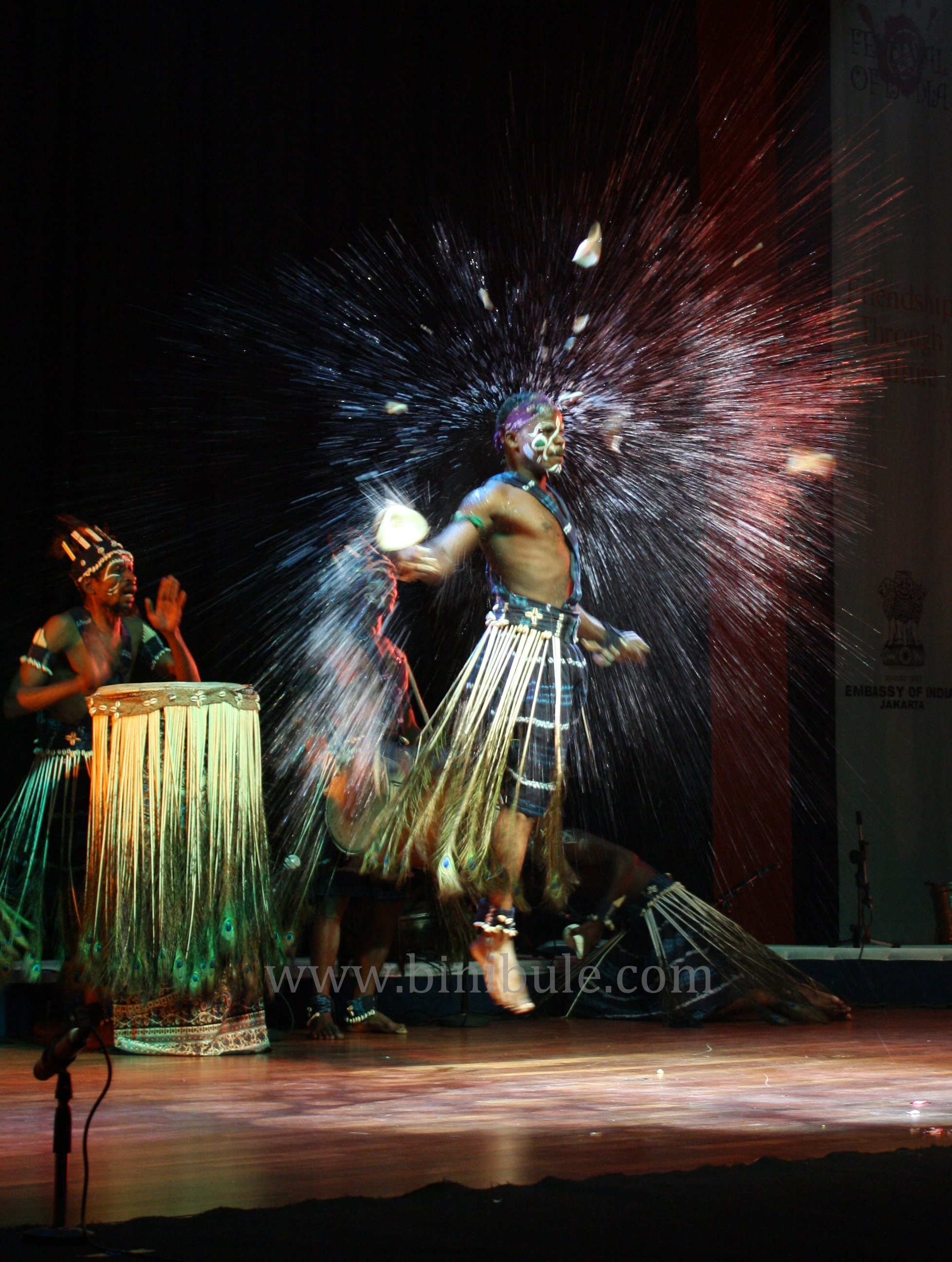
The picture that I chose was taken during the Festival of India in Jakarta back in October 2009. At the time, the Indian Embassy in Jakarta organized a Festival of India to give us a glimpse of the country’s diverse cultures. To support the festival, the Indian Embassy brought cultural performers to Jakarta, and, if I’m not mistaken, Bali, including dance troupes and traditional musicians from all over India.
One of the dance troupes was called Sidi Goma Gujarat; the group consist of only 5 tribal dancers and 4 drummers of East-African origin whose ancestors have lived in Gujarat India since 8th centuries. All performers were men. I read somewhere that the group normally consists of 12 performers, including 8 dancers and 4 drummers.
Sidi or Siddi means “slaves”, but there are those who argue that it means “master”. Back in the 8th Centuries, the Africans were brought to India as slaves, concubines or merchants. Because of their physical quality, they were also brought to India to do security related jobs, like soldiers, palace guards or personal body guards. Today, there are more than 30,000 Sidis lives in Gujarat and they are well known as a devout Sufi Muslims.
Although Sidis, who are also known as Habshi, have successfully assimilated into their adopted country and speak the local language, they are often discriminated against. This is because of their appearance, which does not carry any typical Indian characteristic or features. In one of the articles that I read, the Sidi Goma performers were once accused of being a Nigerian group who had forged Indian passports to travel. Sidis also often have to pay more than the local because the sellers think they are tourists, not local. According to theeastafrican.co.ke, Sidis are also stereotyped as “lazy, potentially talented in music and sports, but incapable of intellectual endeavor”.
The dance and the sacred music of Sidi Goma Gujarat usually performed during rituals at the Shrines to Bava Gor, the patron Saint of the Sidi. During the performance, the dancers and the drummer were dressed in peacock feather skirt and their faces were painted. The peacock feather skirt is an Indian influence, while face paint is African.
Contrary to what I expected, the dance was far from serious. It was very playful. They sang, danced and had fun like a group of ecstatic young boys. The humor was also at the heart of the dance; in one of the dance parts, they stuck out their tongues and posed for us. Unfortunately, I could not get a good picture of them posing because I was sitting far from the center of the stage.
At the end of the dance, one of the dancers tossed a coconut into the air and cracked it open with his head. I snapped a few pictures, but my favorite is the one where the dancer is mid-air as the coconut breaks and water splashes all around him. I was so glad I wasn’t seated near the center of the stage. Had I been, I would have captured a very different, less dramatic picture.
Have a fabulous weekend everyone!
xx,
Tjetje






Show me love, leave your thought here!